Thailand One-Stop Engineering Solution

1. Project Background

This project is located in Chonburiชลบุรี) Province, one of the key industrial manufacturing hubs in Thailand. The client planned to construct an industrial steel structure workshop to support the installation and operation of an automated production line.

The project consists of a steel structure industrial workshop for automated production, with overall dimensions of 136 m in length and 72 m in width. The building adopts a four-span structural system with 18 m column spacing, and is equipped with large-span overhead cranes to facilitate material handling and equipment movement. In addition, the project includes industrial foundations for the automated production line, designed to meet equipment load and operational requirements.

The main structural challenge of this project lies in the large cantilever canopy system on both sides of the workshop. Each side features an 8 m wide cantilever canopy without supporting columns beneath, with the entire structure stabilized through lateral force transfer by the side steel columns. This design ensures open space for logistics operations while placing higher demands on structural stability and connection design.

2. Structural Design Phase

The structural design of the four-span workshop was completed within 30 days, with a focus on reducing structural weight while maintaining safety and operational efficiency.

The building adopts a four-span layout with 18 m column spacing, and all spans are equipped with 20-ton overhead cranes to meet heavy-duty production requirements. In addition, based on the client’s workflow optimisation, two additional 6-ton cranes were introduced at the 6 m elevation, allowing more flexible and efficient transportation of raw materials within the workshop.

Regarding material selection, the initial plan was to use Hot-Rolled Beam. After optimization, the design was adjusted to Welded Beam. Although fabrication costs increased slightly, the optimized sections reduced the overall steel consumption, resulting in a lower total project cost.
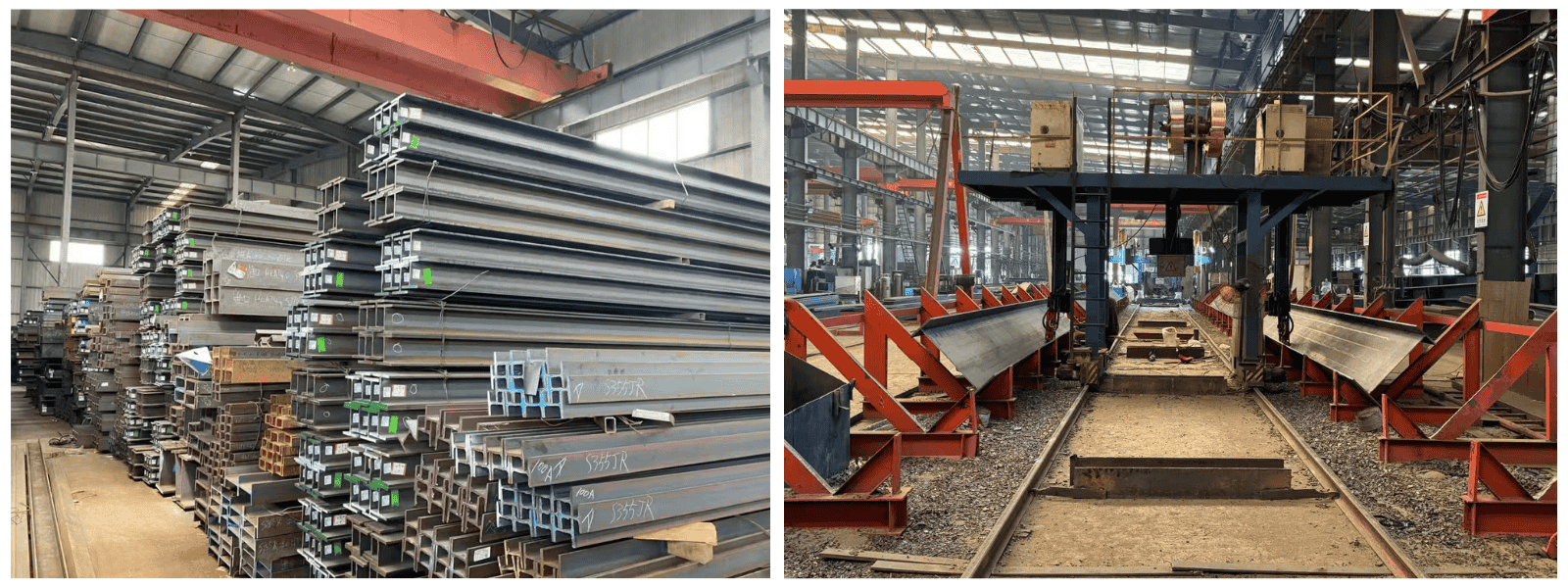
For the lateral stability system, ladder-type cross bracing was adopted between columns, enhancing resistance to lateral loads and improving the global stability of the structure.

Additional design considerations included:

    1. Optimization of structural force distribution
    2. Coordination between crane beams and the main structure
    3. Design adaptation for large cantilever canopies
    4. Improved connection detailing for fabrication and installation efficiency

Through these optimizations, the project achieved a well-balanced solution in terms of structural performance, cost control, and constructability.

3.Fabrication + Logistics Integration
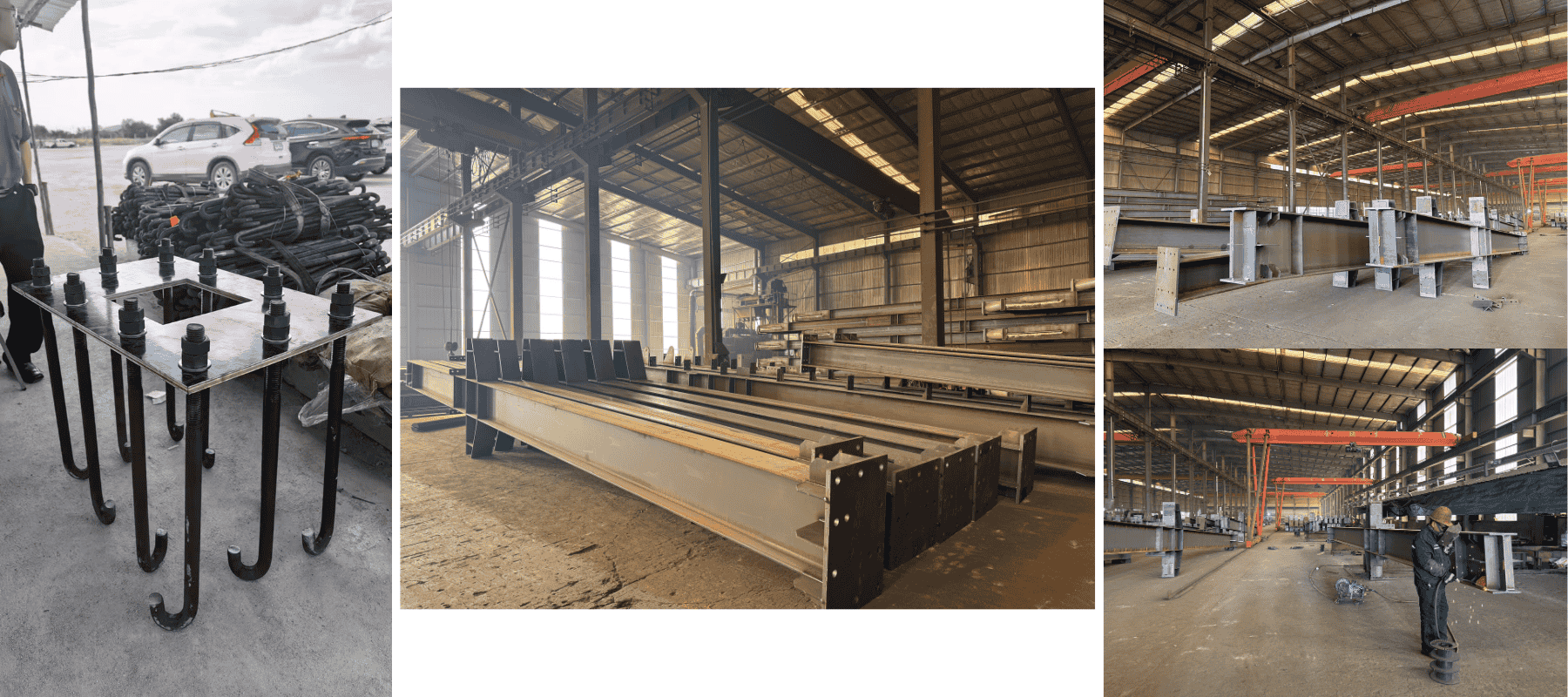
Following the completion of the structural design, the project quickly entered the fabrication and logistics phase, with a strong focus on synchronisation between production, shipping, and on-site installation.The fabrication process was carried out in a standardized and highly controlled production workflow:

    1. Laser cutting was used to process raw steel plates into precise components
    2. The cut plates were then assembled and welded into H-shaped sections using automated welding machines, forming the primary steel beams and columns
    3. Structural members were further assembled and fitted to ensure dimensional accuracy and connection compatibility
    4. Completed components were transferred to the shot blasting and painting workshop, where surface treatment improved corrosion resistance and coating adhesion

Additional process controls included:

    1. Dimensional inspection and quality checks
    2. Weld seam inspection to ensure structural integrity
    3. Pre-assembly of critical connection nodes for installation efficiency

This integrated fabrication process ensured high precision, consistent quality, and readiness for rapid installation.

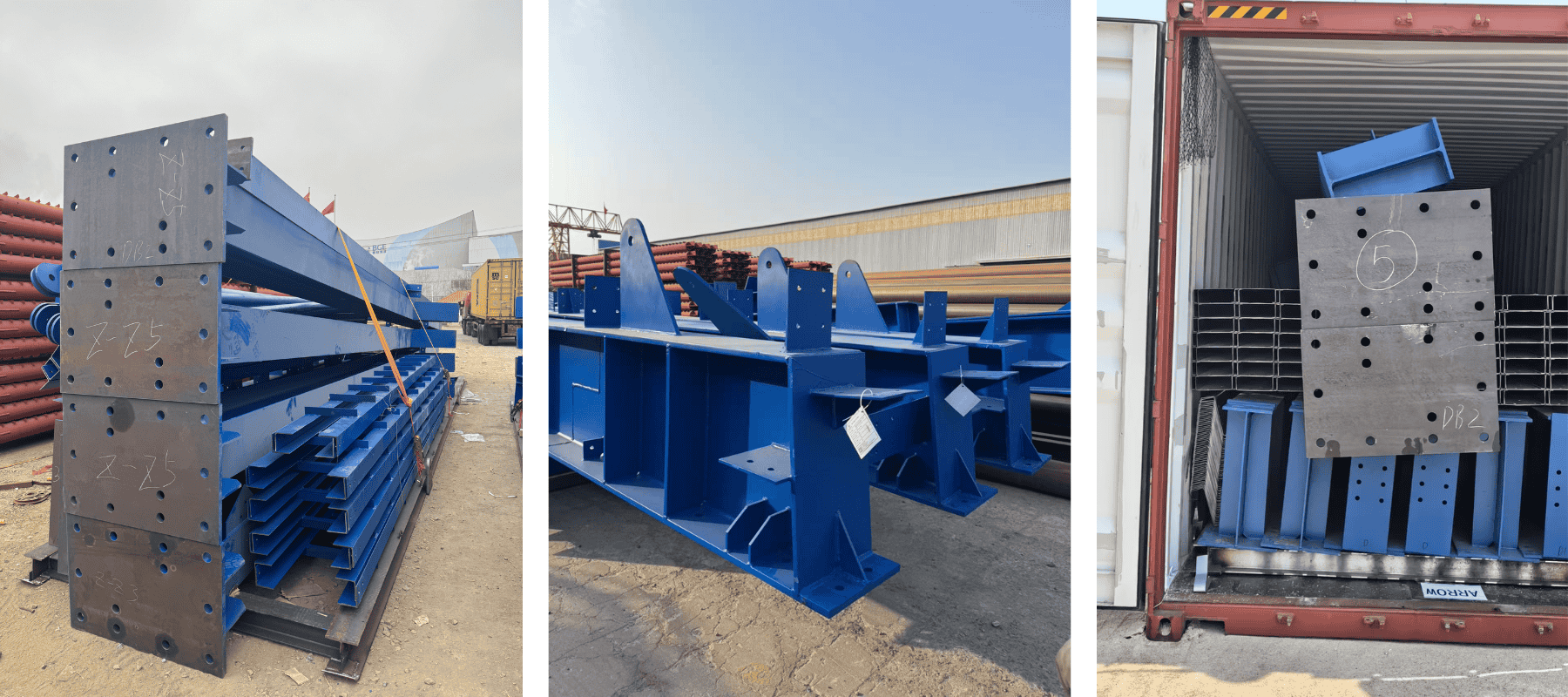
The first batch shipment included steel columns, partial steel beams, and bracing components, ensuring that the site installation could commence as early as possible. All components were loaded and transported by sea, with an average shipping duration of approximately 30 days to reach the project site in Thailand.

To ensure product integrity during transportation, all steel members were secured using customized steel pallets and external fixation systems. This packaging method allowed the components to remain in their original bundled condition upon arrival, effectively minimizing damage caused by long-distance marine transportation.

After the first batch arrived on site, materials were unloaded and distributed according to installation zones, and erection of the steel columns began immediately. Meanwhile, the second batch of steel components was dispatched from the factory, aligning with the on-site installation progress.

This approach formed a continuous workflow cycle of fabrication → shipping → installation, ensuring that:

    1. On-site workers maintained continuous productivity
    2. Storage pressure at the site was minimized
    3. The project schedule was significantly optimised

Through this phased delivery and synchronized execution strategy, the project achieved high efficiency in both logistics management and construction progress, demonstrating HHY Steel Structure’s capability in handling international EPC steel structure projects.

4. On-Site Installation

The project adopts a half-span installation strategy, allowing construction and equipment installation to proceed in parallel. After one half of the structure is completed, the site proceeds with ground leveling and preparation, enabling the production equipment installation team to enter and begin setting up the automated production line simultaneously.

Although this approach slightly increases overall coordination and construction costs, it significantly improves project efficiency and aligns with the client’s requirements. In practice, this method has proven to be both reasonable and effective, optimizing the overall project schedule.

At present, the project is progressing smoothly. Approximately half of the workshop structure has been completed, and the site is currently undergoing ground leveling works in preparation for equipment installation.

Installation Sequence

The general installation sequence is organized as follows:

    1. Steel column erection
    2. Main beam installation
    3. Roof truss and secondary structure installation
    4. Bracing system installation
    5. Roof and wall system installation
    6. Final structural alignment and inspection

Through this phased and coordinated installation approach, the project ensures efficient execution while maintaining structural quality and construction safety.

5.Project Management, Current Progress & HHY Steel Structure Capability

This project reflects HHY Steel Structure’s integrated capability in design, fabrication, shipment, and on-site installation for overseas industrial steel structure projects.

During project execution, the factory team in China and the installation team in Thailand maintained close coordination. Based on the actual construction requirements, the project adopted a phased production, phased shipment, and phased installation approach, so that fabrication progress, shipping schedule, and site erection could remain closely connected. This management method helped ensure that materials arrived on site in line with installation needs, reducing waiting time and improving overall construction efficiency.

To better match the client’s production plan, the project also adopted a half-span installation strategy. After one half of the workshop structure was erected, ground leveling works could begin in that area, allowing the equipment installation team to enter the site earlier for the installation of the production line. Although this method increased coordination difficulty and slightly raised construction cost, it was reasonable for the project and helped improve the overall schedule arrangement.

At present, the project is progressing smoothly. Half of the workshop structure has already been completed, and the completed area is now entering the ground leveling stage, preparing for the next step of production line installation. The overall project is advancing in an orderly manner.

This project also highlights several key strengths of HHY Steel Structure:

    1. Integrated project execution from design to installation
    2. Flexible coordination between fabrication, shipment, and site progress
    3. Experience in large-span industrial steel structure projects
    4. Ability to support automated production line buildings with customized structural solutions

Through this project, HHY Steel Structure once again demonstrates its ability to provide practical and efficient steel structure solutions for overseas industrial developments.